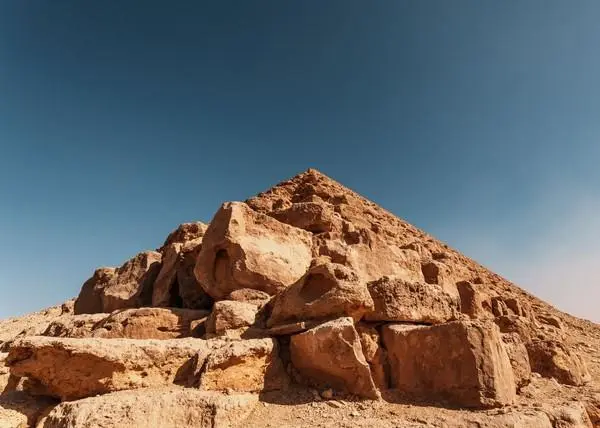
Discovery of an Ancient Pyramid in the Judean Desert: A 2,200-Year-Old Mystery That Captures the Imagination.
Imagine standing in the middle of the barren Judean desert, Israel, where the hot wind sweeps across ancient sands holding the secrets of history. Recently, a team of archaeologists from the Israel Antiquities Authority (IAA) unearthed a giant pyramid structure approximately 2,200 years old, which is now at the center of expert debate. The structure, called the "Zohar Fortress," is located on a hilltop near the Dead Sea, north of Nahal Zohar—about 20 kilometers south of the legendary site of Masada. It is not an Egyptian-style pyramid, but a monumental building nearly 6 meters high, constructed from roughly hewn hand-cut stones, each weighing hundreds of kilograms. This discovery is not just stacked stones; it is like a time capsule full of riddles.
Initially, scholars suspected the structure dated back to the First Temple period (around the 10th century BCE), but new evidence overturned that theory. Artifact analysis indicates the pyramid was built during the Hellenistic period, around the 3rd to 2nd centuries BCE, when the region of Israel was controlled by the Ptolemaic dynasty of Egypt and later the Greek Seleucids. At that time, Alexander the Great had just died, and the Middle East became an arena for power struggles. "This is one of the richest and most interesting excavations in the Judean Desert," said excavation directors Matan Toledano, Dr. Eitan Klein, and Amir Ganor, as reported by the IAA. They even invited volunteers from across the country to join, making the discovery feel like a shared adventure.
What was found inside? A treasure trove incredibly well-preserved thanks to the dry desert climate: papyrus fragments inscribed in ancient Greek, bronze coins from the time of Antiochus IV and the Ptolemaic kings, sharp weapons, wooden furniture, and almost intact textiles. There were also administrative documents that might record the trade of salt and bitumen—precious commodities from the Dead Sea that were exported to Mediterranean ports. The low-humidity environment prevented mold and damage, leaving these artifacts looking almost new. "This discovery is emotional and significant for historical research," said IAA Director Eli Escusido.
But here’s the chilling part: the function of this pyramid is still a mystery. Was it a watchtower protecting trade routes, collecting taxes from merchant caravans? Or perhaps a military post to monitor a strategic area? Some experts speculate it was a memorial monument or even a tomb marker, given its dramatic pyramid shape. "Was this an ancient tax fort, or merely a warning sign on top of a mountain?" Klein asked in an interview with The Times of Israel. What is certain is that the building was abandoned suddenly and collapsed due to an earthquake or flood, leaving behind incomplete clues.
This discovery is part of a national IAA project over the last eight years, surveying 180 kilometers of desert cliffs to protect sites from looters. Thousands of artifacts have been found, including hidden scrolls similar to the Dead Sea Scrolls. Amid modern geopolitical tensions, this finding reminds us of the overlapping layers of history in this holy land—from ancient Greece to Rome.
 Loading


Disclaimer
- All content on this website, including but not limited to text, images, and videos, is not owned directly by us.
- All content on this site, whether text, images, or videos, originates from external sources or User - Generated Content (UGS).
- We are not liable for any loss or damage resulting from the content on this website.
Comments
Leave your comment (spam and offensive messages will be removed)